Three Scenic Winter Hikes


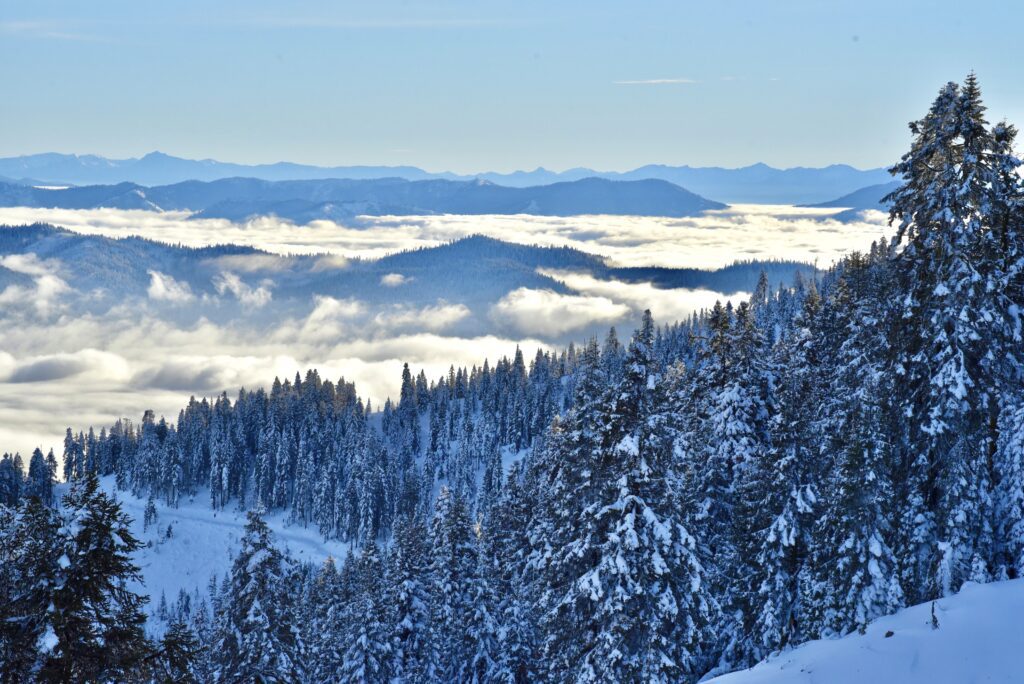
For many, winter means a time to hunker down, stay indoors, and get cozy around the fire. But in Grants Pass, we see the outdoors as a year-round destination where moody forests, sweeping views, and quiet hiking trails await—even in winter.
To get you excited about hiking in the cool season, we’ve rounded up three beloved trails that don’t see much (if any) ice and snow—and which offer views, enjoyable workouts, and a variety of ecosystems all year long. Here’s your guide to winter hikes around Grants Pass.
Cathedral Hills Offer Easy Escape, Plenty of Highlights in Winter
You could spend all winter hiking the 10-mile Cathedral Hills Trail System and still only scratch the surface of what it offers.
Open to hikers, mountain bikers, and horseback riders, the connected network of trails heads through forests of pine, manzanita, madrone, and Douglas fir; occasionally offers sweeping views of the surrounding Rogue Valley and the city of Grants Pass; and even passes a 25-foot-tall whiteleaf manzanita and a 117-foot-tall knobcone pine—both the largest trees of their species. (The trees are unmarked but nevertheless stand out for their dramatic stature.)
There’s never a bad time to visit Cathedral Hills, but winter offers a special treat for outdoor enthusiasts. A trio of trailheads sit just 10 minutes from downtown Grants Pass, offering access to the various loops and connector paths that make it such a fun place to explore. The paths themselves typically remain snow- and ice-free all season long, and the interconnected nature of the system makes it easy to choose outings of varying lengths and levels of intensity. Just beware that poison oak is common along the trail; wear long pants, and stay on the trail to minimize exposure.
Savor Expansive Views, Diverse Ecosystems on the East Applegate Ridge Trail
Take in wide-open views along a gently graded path via the East Applegate Ridge Trail—sometimes known locally as “East ART” or simply “EART”.
Whatever you call it, the trail dazzles with a variety of ecosystems; you’ll dart between panoramic meadows and thick forests (home to oak, madrone, and Douglas fir) while savoring ridgetop views of the Applegate Valley below and the Siskiyou Mountains on the horizon. Keep an eye out to the south, where paragliders occasionally launch from nearby Woodrat Mountain. Best of all, it’s at low enough elevation to stay mostly snow- and ice-free throughout winter. (If you DO encounter wintry weather, it’s easy enough to turn around and still enjoy a fun hike.)
In all, the East Applegate Ridge Trail measures 5.6 miles (one-way) while gaining about 300 feet; a trailhead sits at either terminus, so it’s easy to hike the whole trail if you and a friend have vehicles at both trailheads. If you’d rather not do an 11.2-mile round-trip trek, you’ll find a bench roughly halfway through that makes a fine turnaround point.
The path’s trailheads sit just 15 minutes south of Jacksonville and 45 minutes southeast of Grants Pass.
Carnivorous Plants Await at the Eight Dollar Mountain Botanical Wayside
In spring and summer, Eight Dollar Mountain Botanical Wayside hosts some of the most diverse, wide-ranging wildflower displays in Southern Oregon. But by winter, when the colorful blooms have all but disappeared, another attraction takes center stage along the 0.25-mile (round-trip) boardwalk path.
In winter, the Darlingtonia californica—also known as the cobra lily—is a genuine spectacle at the quiet wayside, roughly 30 minutes southwest of Grants Pass. The tall, stalky carnivorous plant can grow 10 to 20 inches and (unsurprisingly) looks a bit like a cobra that’s ready to strike; it survives by trapping and feeding on insects in the wetlands near the end of the trail. The unique plants are fascinating sights in all four seasons, but they appear to grow slightly larger and more impressive when fed by winter rains.